Explain the Different Reinvestment Rate Assumptions of Npv and Irr
Learn the definition and calculation of IRR and understand. On the other hand IRR ie.

Pdf Reinvestment Rate Assumptions In Capital Budgeting A Note Ken Johnston Academia Edu
Business Finance QA Library What reinvestment rate assumptions are built into the NPV IRR and MIRR methods.

. Calculations of net present value NPV by contrast generally assume only that a company can earn its cost of capital on interim cash flows leaving any future incremental project value with those future projects. NPV or otherwise known as Net Present Value method reckons the present value of the flow of cash of an investment project that uses the cost of capital as a discounting rate. The results from NPV show some similarities to the figures obtained from IRR under a similar set of conditions.
This question hasnt been solved yet Ask an expert Ask an expert Ask. Project cash flows are reinvested at the projects own IRR. Whereas NPV assumes a rate of borrowing as well as lending near to the market rates and not absolutely impractical.
Although the IRR is easy to calculate many people find this textbook definition of IRR difficult to understand. 19000 per year for 10 years. The difference is NPV is the sum of the present values of the cash flows at a particular interest rate whereas IRR is the interest rate that will cause the NPV to be equal to zero Cornett Adair Nofsinger 2016 p321.
The NPV has no reinvestment rate assumption. To solve the conflict he suggested that the analyst make an. Givean explanation for your answer.
The internal rate of return IRR considers the rate of return required for the net present value of an investment to be equal to zero. In the lifespan of every company. What reinvestment rate assumptions are built into the NPV IRR and MIRR methods.
IRRs assumptions about reinvestment can lead to major capital budget distortions. Meanwhile the internal rate of return IRR is a discount rate that makes the net present value NPV of all cash flows from a particular project equal to. As the NPV is not skewed by the overstated reinvestment rate assumption hence it.
So with these numbers you would have a present value of 19000 in cash flow for 10 years at a discount rate of 14. The two tools have different reinvestment rate assumptions. Since th e NPV is positive y ou h ad n ot disco unt ed th e cash flow s by a large enoug h value so try again.
Which reinvestment rate assumption is more realistic and why. This is because in case of Project C more cash flows are in Year 1 resulting in longer reinvestment periods at higher reinvestment assumption and hence it has a higher IRR. The reinvestment rate assumption is widely used to help investors future proof their actions and ensure the greatest possible degree of return.
In the previous post the potential origins of the Reinvestment Assumption were examined as well as its discrediting by academics in the peer-reviewed literature. The IRR has a reinvestment rate assumption that assumes that the company will reinvest cash inflows at the IRRs rate of return for the lifetime of the project. IRR enters the problem of multiple.
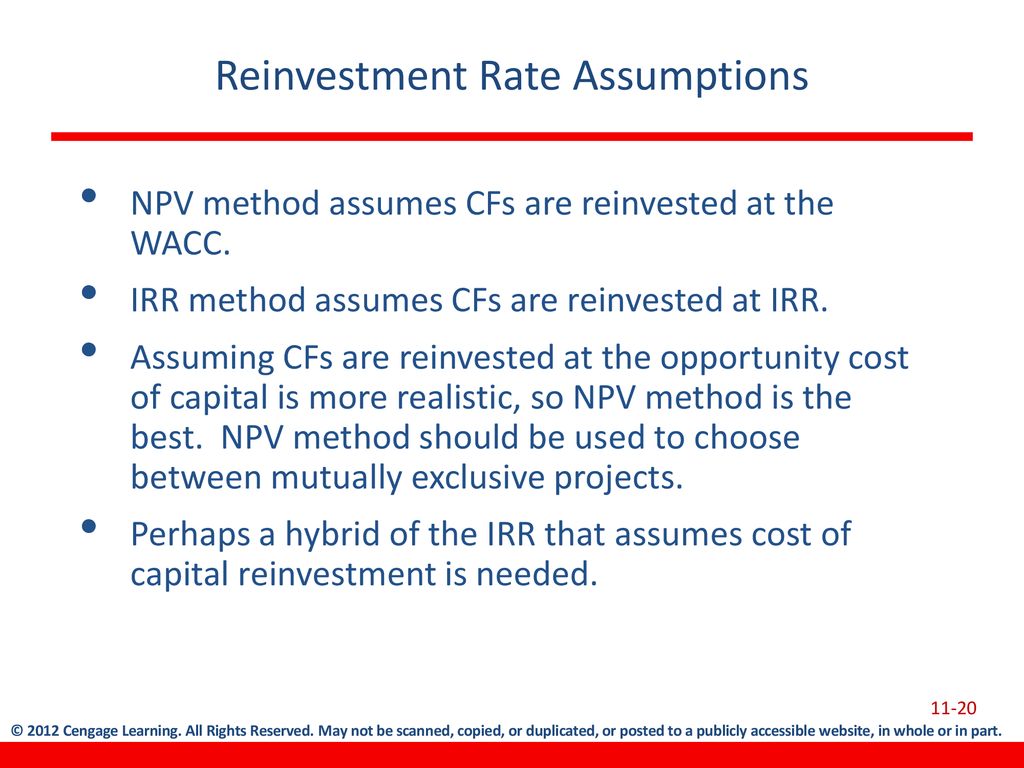
The presumed rate of return for the reinvestment of intermediate cash flows is the firms cost of capital when NPV is used while it is the internal rate of return under the IRR method. NPVs presumption is that intermediate cash flow is reinvested at cutoff rate while under the IRR approach an intermediate cash flow is invested at the prevailing internal rate of return. A reinvestment rate assumption is defined as the.
The NPV is 99106. At a discount rate of 8 you get an NPV of 0 and this is the IRR. Explain the NPV and IRR methods and the difference between the reinvestment rate assumptions are built into each.
According to the author the cause of the conflict lies in the different reinvestment assumptions of IRR and NPV. In turn this is not a good investment because you are paying 135000 for a cash flow that is only worth 99106 at 14. Approaching the question For NPV the reinvestment assumption is that funds are reinvested at the market determined cost of capital.
It is the rate at which NPV of terminal inflows is equal to the outflow ie. Weve got the study and writing resources you need for your assignments. Rental property income.
The latter is unrealistic as it is possible for two projects with the same risk to have different IRRs and hence reinvestment rates. The textbook definition of IRR is that it is the interest rate that causes the net present value to equal zero. This time if you guess 10 you would get an NPV of about -21 so you had discounted too much and need to try a lower value.
Internal rate of return is a rate of interest which matches present value of future cash flows with the initial capital outflow. Project cash flows are reinvested at the cost of capital. Despite both having the same initial investment Project C has a higher NPV but Project D has a higher IRR.
The NPV would be arou nd 21. The NPV method requires the use of a discount rate which can be difficult to derive since management might want to adjust it based on perceived risk levels. If the IRR of a very good project is say 35 it is practically not possible to invest money at this rate in the market.
For IRR the assumption is that funds can be reinvested at the IRR. Net present value method also known as discounted cash flow method is a popular capital budgeting technique that takes into account the time value of moneyIt uses net present value of the investment project as the base to accept or reject a proposed investment in projects like purchase of new equipment purchase of inventory expansion or addition of. Solomon believed that both NPV and IRR have implicit reinvestment rates the former at the cost of capital the latter at the IRR itself.
Offered here is an explanation of why the discrepancy between NPV and IRR for ranking investments which leads some to invoke of the Reinvestment Assumption should be quite evident. In addition a clear. It is the rate at which NPV is equal to zero.
Therefore the reinvestment rate will not change the outcome of the project. IRR assumes discounting and reinvestment of cash flows at the same rate. The internal rate of return IRR is a financial metric used to measure an investments performance.

Pdf The Reinvestment Rate Assumption Fallacy For Irr And Npv
The Basics Of Capital Budgeting Ppt Download
The Basics Of Capital Budgeting Ppt Download


Comments
Post a Comment